How GOF AI Agents Turn Natural Language into Complex ECOs in Minutes
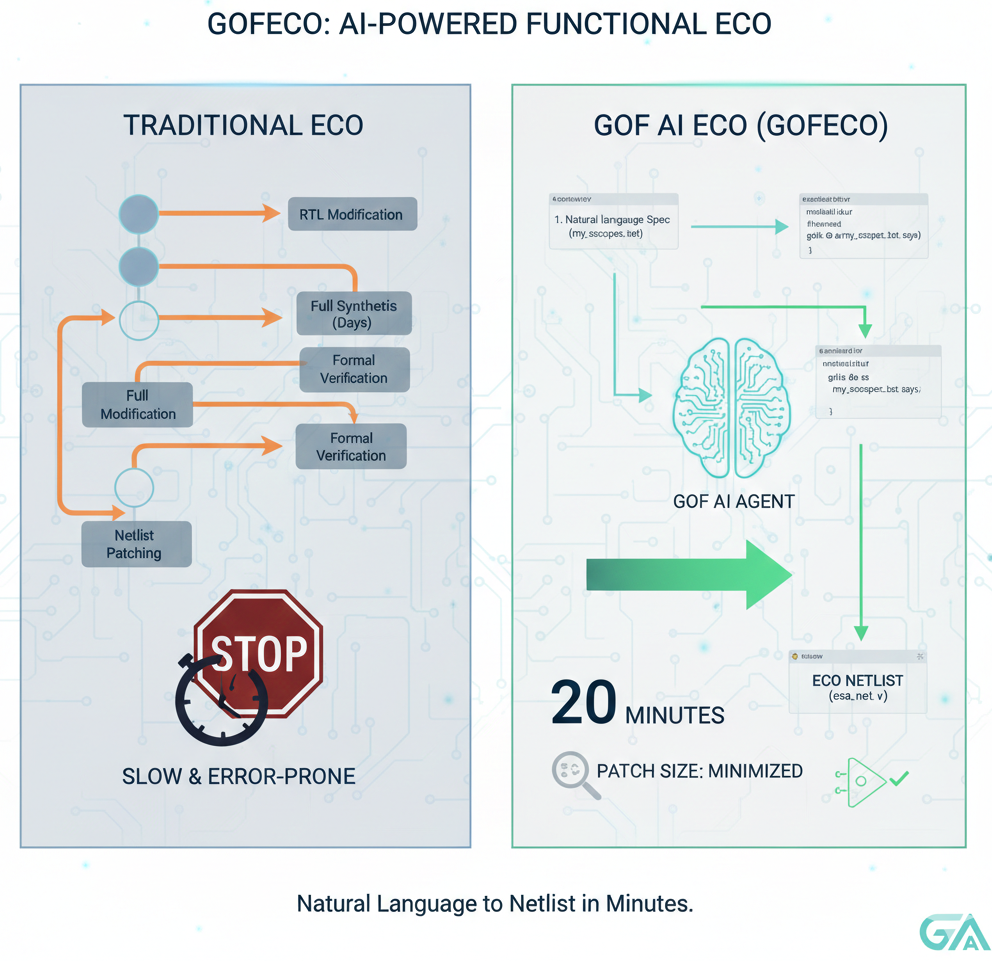
In the high-stakes world of digital IC design, ECOs are inevitable. Often occurring late in the design cycle, facing critical tape-out deadlines, functional ECOs are traditionally a major bottleneck. The conventional process—modifying RTL, re-synthesizing the entire design, and performing formal verification against the original netlist—is excruciatingly slow and resource-intensive.
GOF ECO is changing this paradigm entirely with the introduction of GOF AI Agents. By leveraging advanced natural language processing and RTL-guided methodology, GOF AI transforms complex ECO tasks into simple, conversational requests, dramatically reducing turnaround time and engineering effort.
The Paradigm Shift: RTL-Guided ECO without Re-Synthesis
The most significant advantage of the GOF AI approach is the elimination of the lengthy re-synthesis process.
Traditionally, even a small functional change required re-running synthesis on the entire design block to generate a new reference netlist. GOF AI’s "RTL Guided ECO" feature bypasses this requirement. It intelligently analyzes the difference between the original RTL and the modified RTL, mapping those functional changes directly onto the existing pre-layout netlist.
The results are staggering. In recent benchmarks, GOF AI Agents completed a complex functional ECO on a massive 2 million instance netlist in just 20 minutes. What once took days of compute time and engineering oversight can now be accomplished over a coffee break.
The Workflow: As Simple as Asking
GOF AI has democratized the ECO process. You no longer need to be a netlist manipulation expert to implement changes or learn the complicated syntax EDA scripts. The interface is designed around natural language intention.
An engineer simply needs to define the scope of work in a plain text specification file, identifying the inputs (original RTL, modified RTL, target netlist) and desired outputs.
A Real-World Example
Imagine a scenario where a late bug is discovered in the chipdigt_top module. The RTL designer fixes it in modified_rtl.sv. Instead of launching synthesis, the backend engineer creates a simple natural language specification file, my_ecospec.txt:
Do a RTL guided automatic ECO
Top module name: chipdigt_top
Netlist under ECO: prelayout.v
Original RTL file: original_rtl.sv
Modified RTL file: modified_rtl.sv
Save ECO Perl script to: eco_perl.pl
Save ECO netlist to: eco_net.v
To execute this complex operation, the user issues a single, intuitive command in the Linux terminal:
gofai do as my_ecospec.txt says
The GOF AI Agent parses this natural language request, understands the intent, sets up the environment, compares the RTL files, identifies the necessary logic changes, and applies them to the prelayout.v netlist, automatically generating the final netlist and a corresponding script.
Intelligent Consulting: Minimizing Patch Size
GOF AI Agents act as more than just automated script runners; they function as intelligent design assistants.
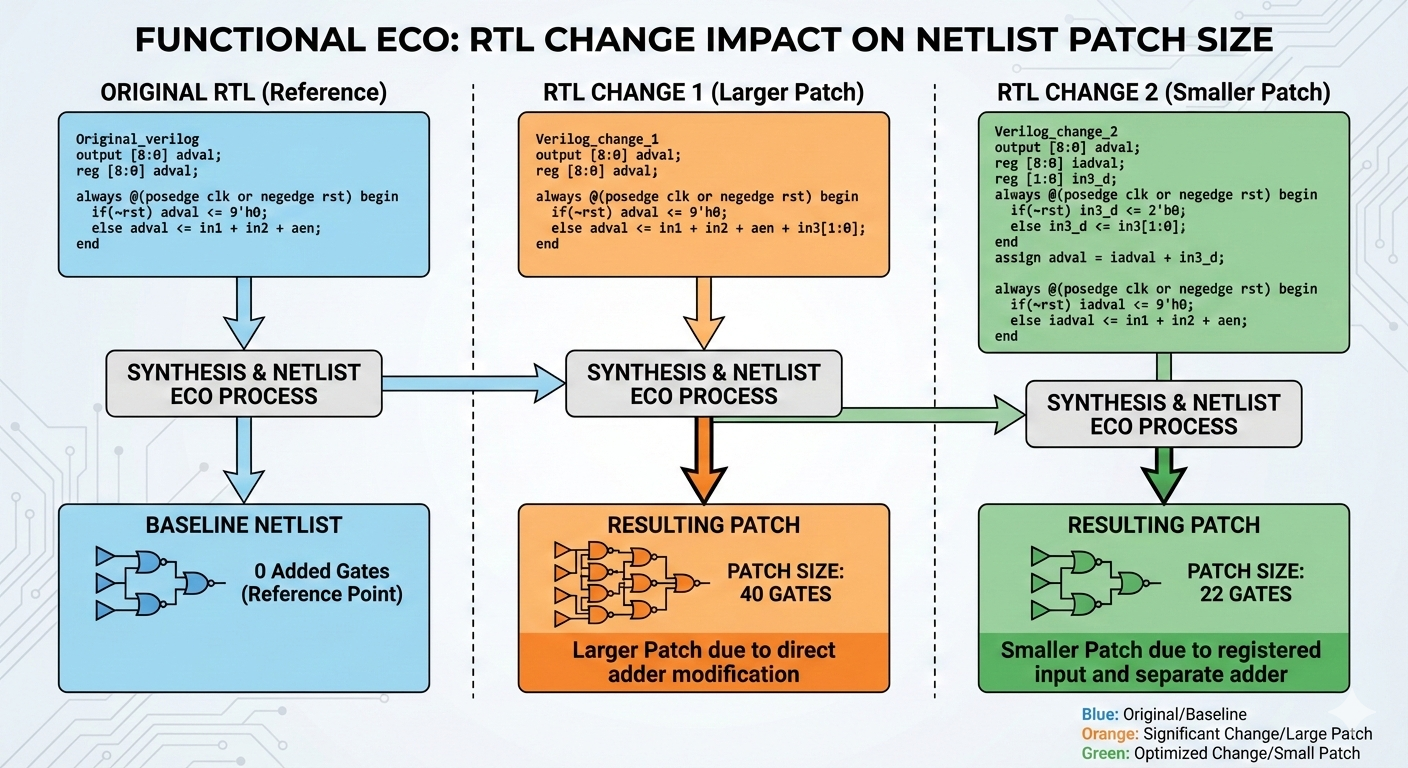
A critical metric in late-stage ECOs is patch size. A large number of added gates can disrupt timing closure and cause congestion. GOF AI Agents analyze the requested changes in the modified_rtl.sv and provide proactive suggestions for re-modeling the RTL code.
By suggesting alternative coding styles that are functionally equivalent but structurally more friendly to the existing netlist logic, the AI ensures that the final ECO patch size is minimized. This capability not only speeds up the implementation but also significantly increases the chances of preserving existing timing and layout structures.
Conclusion
GOF AI Agents in GOF ECO represent a massive leap forward in physical design automation. By replacing brute-force re-synthesis with intelligent, natural language-driven, RTL-guided methodologies, GOF turns the most stressful part of the design cycle into a manageable, rapid task. For design teams facing tight deadlines on multi-million gate designs, GOF AI is no longer just a tool—it's a necessity.